
Insights & advice
Forged through service.
Six years in the Air Force gave me structured systems, a way to find where a problem lives and a way of talking to people that gets to the truth. Here is how that became Prismonde.
Damien Foord, Partner
I enlisted in the Air Force in 2006. By then it was clear that September 11 was the defining event of my generation, and I wanted to play my part and to know, looking back, that I had seen it first hand rather than watched from the sidelines.
I started in law enforcement, which looked a lot like being a small-town police officer, and it was there that I was trained in forensic interviewing and human intelligence. I took that training to Iraq for two tours attached to US Army units, where much of my job was collecting information, judging how far I could trust it and working out how to get better information.
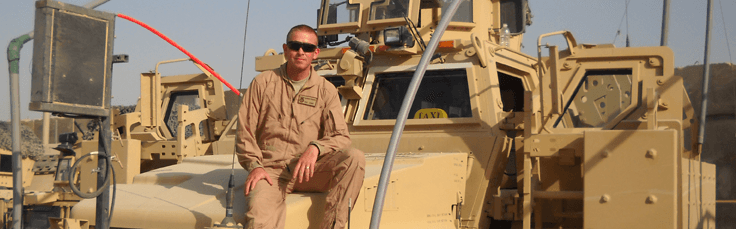
Iraq
I was in my early 20s there, leading men younger than me, and during those tours people in my unit got hurt. What stayed with me was how the stakes work. One thing causes another, that changes something else, and somewhere down the line a person gets hurt with no straight line back to where it started. Most of that is out of your hands, so you take hold of the part that isn’t, which is the quality of your own work. People get hurt, and when they do, I want them to be dealing with the best work I could manage and not with a shortcut.
Iraq also changed how I saw people. I had gone in seeing the world as us against them. Then my son was born while I was deployed, and local people brought food, baby clothes and other gifts to celebrate. My interpreter, an American citizen born in Iraq and now working alongside us, had many conversations with me, watched my back and taught me to look out for the things a young man misses and an older man knows to watch for. He protected me the way a father protects a son, and he explained as he went what he was protecting me from. I came home seeing people who are trying to do good and people who mean harm, and finding both in every culture.
Somewhere in all of that I was also running a business. I had kept a small design practice going on the side while I served, and in Iraq I spun out a clothing line. I researched the distributors who handle merchandise for music artists, wrote to one of them and negotiated the kind of deal usually reserved for an artist with an audience, which left me free to design the apparel while they handled nearly all of the production and distribution. I did that, and looked after my design clients, between trips outside the wire.
After Iraq I was part of a team running a program for service members on their way home from combat. I was chosen because of my own combat experience, which meant the people in the room could trust that I knew what they were talking about. We facilitated group discussions as structured interviews, where each group went back through its deployment from beginning to end and worked out what had gone wrong, both to understand its impact and so that the next unit could do better. The interviewing I had learned in law enforcement and used in Iraq got better results there too, because people confided in me about what had actually happened.
Coming home
I left the service at 26, having served around the world, and leaving frightened me. I had a business and some success behind me and I still didn’t know how any of it would translate, which is where a lot of veterans find themselves. The stretch between leaving and being understood is deeply uncomfortable.
Mine was short, and I owe that, largely, to the kindness of strangers. I am hugely grateful to The COMMIT Foundation and Singularity University, each of which connected me with investors and mentors who took the time to understand what I had accomplished and to translate it for others. It was on their recommendation alone that I was given the chance to connect what I could offer with the people who could use it. I feel for anyone starting their life over among people who don’t know how to read what they have done.
What I took with me
My time in service afforded me some incredible lessons. The Air Force runs everything to a checklist, and it drills into you that breaking a job down into a precise system is how you control the quality of the work. Once a job is broken down that way you can also find what is wrong with it, because you can test each part and measure each step until the fault shows itself. The rest you have to get from people, and I learned how to talk to them in a way that gets to the truth quickly and how to use that truth to get the job done.
That is how Prismonde works. We go into a company whose growth has stalled, break its go-to-market system into parts and find the part that is broken. In every Diagnostic we use the interviewing I learned in the service to separate what a person observed from what they concluded. I do it seeing the person across the table as a human being, which doesn’t change the job to be done.
The stakes came with me as well. A missed plan might be a number to me, but to someone inside that company it might decide whether they can pay the mortgage or send their kids to college, and I don’t get to know which. So we do the best work we can every time.
I found the military to be beautifully practical. They care about what works and so do I. Theory and best practice have their value, but they come second to being effective. I like the moment when the pressure is on and it gets hard to think clearly, and I like having my hand on the wheel when the stakes are high, because that is how the risk stays under control. It is also why Prismonde works for capital. A company in trouble often can’t fix itself, for lack of money or out of pride, but the investors behind it see the problem and want it solved, and that gives us the room to pull a company out of the fire.
To veterans building now
If you’re a veteran in transition, or at a point in life where you’re deciding how to make the most of your time in service, build your network and be generous with it. Everyone you meet can be of use to you and you can be of use to them. Veterans look after each other, and the ones who have done well will open doors and show you the way if you ask.
Don’t doubt yourself. The best way to find out how your skills transfer is to start, to be useful wherever you see a gap and to notice which skills come forward. Then ask the people you helped to explain how it helped them, and you will learn the language for what you can do.
Nobody gets through it alone, so ask for help and take it with gratitude. Someone once told me that refusing help is selfish, because in trying to save face I was denying other people the chance to serve. Take the help, and then be that person for the next veteran who asks.
I hope my story is useful to you, whether you are a veteran finding your way or an investor deciding who to trust with a company. It is the plainest way I know to explain how we see the world at Prismonde, and if I can be of service to you, I would be glad to hear from you.
Read further.
Veteran-owned businesses.
How we work with companies led by people who served, as an SBA-certified service-disabled veteran-owned small business.
How we work.
The four steps every engagement takes. We diagnose, embed, codify and leave.
How the Diagnostic works.
Eight weeks, five systems and two documents, at a fixed fee of $95,000.

Veteran-owned
If you served, tell us.
Tell us about your service when you scope the work, and we will explain how we work with veteran-owned businesses.